Done right, a crate becomes your puppy’s favorite place — a den where they feel safe, settle quickly, and learn to hold their bladder. Done wrong, it becomes a source of anxiety and a nightly battle. The difference is almost always pace: people who struggle moved too fast. The method below is built to go slow on purpose, because the slow version is the one that sticks.
Why crate training works
Dogs are descended from den animals, and most will naturally seek out a snug, enclosed space to rest. A crate gives them that. It also makes house training dramatically easier: a puppy instinctively avoids soiling the area where it sleeps, so a correctly sized crate teaches bladder control almost on its own.
The single most important rule: the crate is never a punishment. If your puppy associates it with being scolded or banished, the whole system collapses. Everything that happens in or near the crate should be neutral or good.
Choosing the right crate
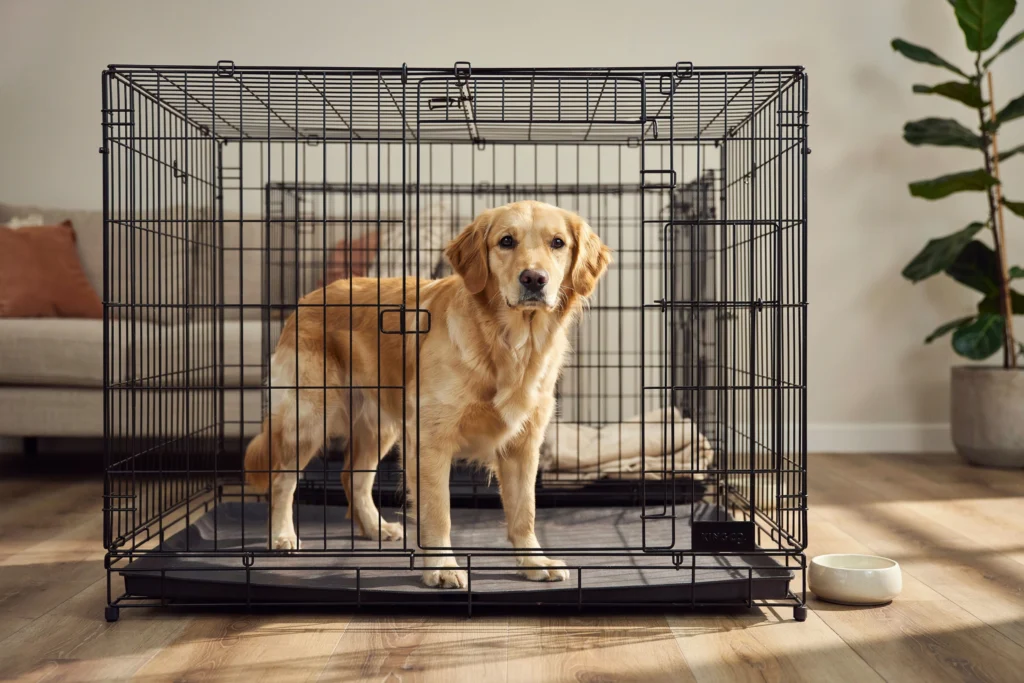
Size matters more than people expect. The crate should be just big enough for your puppy to stand up, turn around, and lie down comfortably — and no bigger. Too much space lets them potty in one corner and sleep in another, which defeats the house-training benefit.
Since puppies grow fast, buy a crate sized for the adult dog and use a divider panel to shrink the usable space while they’re small. Expand it as they grow.
The step-by-step method
Step 1: Make the crate inviting (Day 1–2)
Set the crate up in a room where the family spends time, not isolated in a basement or laundry room. Prop the door open so it can’t swing shut and startle your puppy. Toss a few small treats inside and let your puppy discover them on their own. Don’t lure, push, or close the door yet. The only goal right now is for the crate to be a place where good things appear.
Step 2: Feed meals inside (Day 2–4)
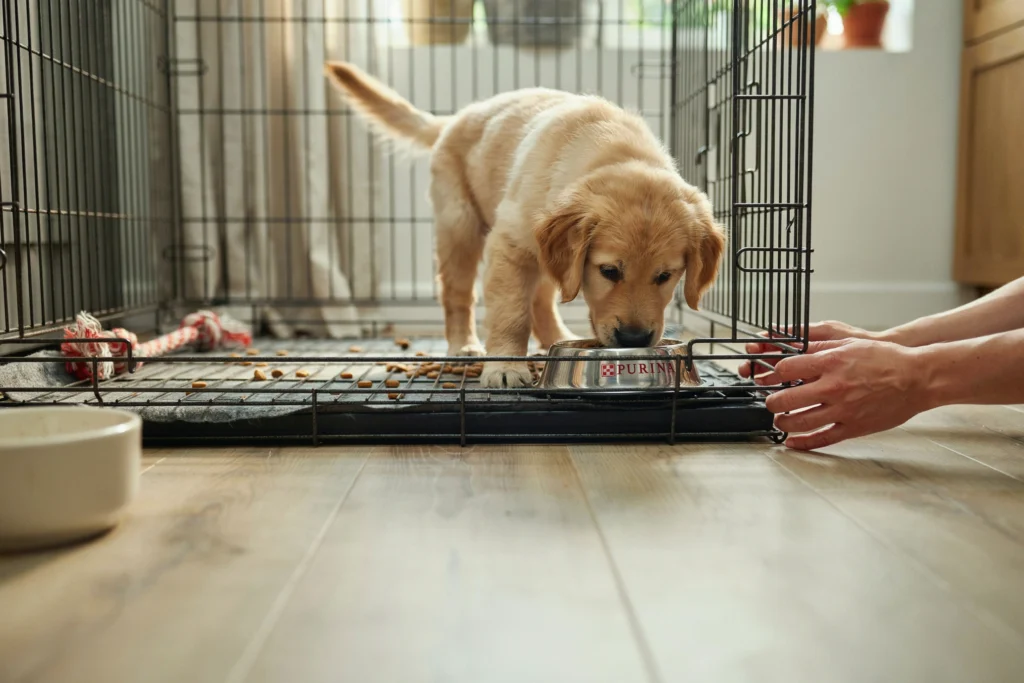
Start placing your puppy’s food bowl inside the crate, near the entrance at first, then gradually further back over several meals. Keep the door open the whole time. Eating is a relaxed, positive activity, and doing it inside the crate builds a strong good association.
Step 3: Close the door briefly (Day 4–7)
Once your puppy walks in willingly, close the door for a few seconds while they eat, then open it before they finish. Add a few seconds each meal. If they panic or whine, you’ve gone too fast — back up to a shorter duration. Stay calm and undramatic about the whole thing; your energy sets the tone.
Step 4: Add a cue word
As your puppy heads in for a treat or meal, say a consistent cue like “crate” or “bed.” Reward them once they’re inside. After enough repetitions, the word alone will send them in.
Step 5: Build duration while you’re present (Week 2)
Have your puppy go in, give them a long-lasting chew or a stuffed food toy, close the door, and sit nearby. Start with five to ten minutes, then gradually extend. Stay in the room at first so they learn that a closed door doesn’t mean abandonment.
Step 6: Practice leaving the room
Once your puppy is comfortable with the door closed and you nearby, start stepping out of sight for short periods and returning calmly. Vary the length so they can’t predict it. Keep arrivals and departures low-key — no emotional goodbyes, no excited reunions. The message you want to send is that your leaving and returning is completely ordinary.
Step 7: Use it for naps and overnight
By now the crate should feel safe enough for real sleep. Many puppies do best with the crate beside the bed at night so they’re not isolated, and so you can hear when they genuinely need to go out.
How long can a puppy be crated?
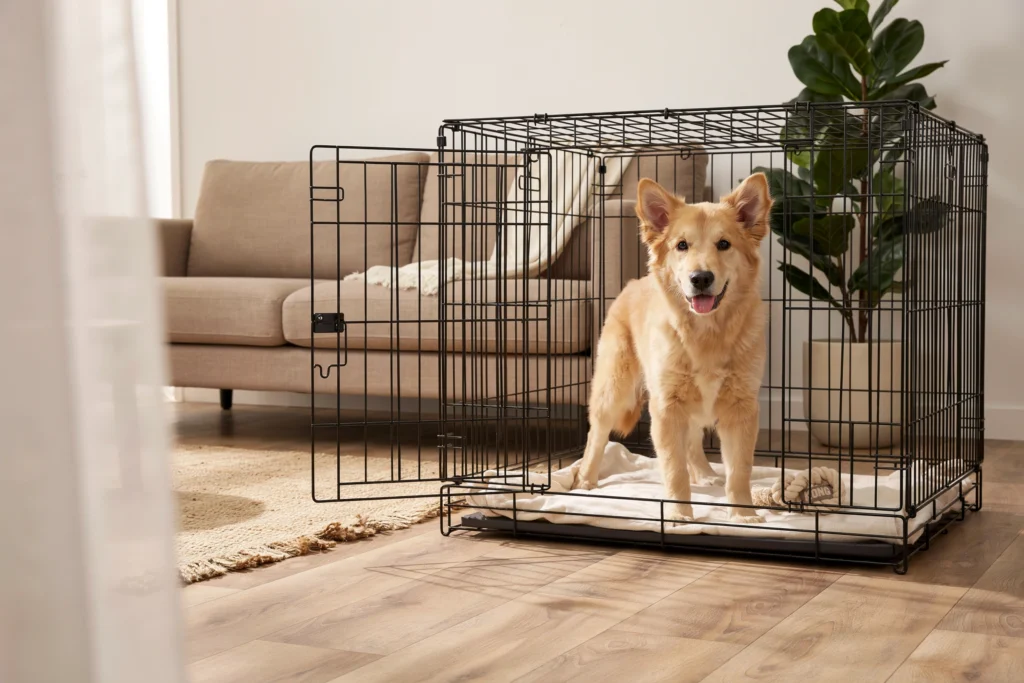
A rough guideline: a puppy can hold its bladder for about one hour per month of age, plus one — so a two-month-old maxes out around three hours during the day, and a four-month-old around five. This is a ceiling, not a target. Young puppies should not be crated for long daytime stretches; they need frequent potty breaks, play, and human contact. Overnight they can often hold it longer because their systems slow down during sleep, but expect at least one middle-of-the-night trip outside with a very young puppy.
Handling the whining
This is where most people make mistakes in both directions.
If your puppy whines right after going in, it’s often a settling protest that fades in a minute or two — waiting it out is usually right. But if the whine is urgent, escalating, or comes after a few hours, it likely means they need to potty. The skill is learning to tell the two apart, which comes faster than you’d think.
When you do let a whining puppy out to potty, make it boring and businesslike: straight outside, potty, brief praise, back to bed. No play, no fuss. If you turn a 3 a.m. potty trip into a party, you’ll teach them that whining summons entertainment.
What you want to avoid is the worst-case loop: ignoring genuine need until your puppy is forced to soil the crate (which damages house training), or rushing to release them every time they make a sound (which teaches that noise opens the door).
Common mistakes to avoid
- Moving too fast. Rushing the early steps is the number one reason crate training fails. When in doubt, slow down and shorten durations.
- Using the crate as punishment. Even once. It poisons the association you’ve worked to build.
- A crate that’s too big. It quietly sabotages house training.
- Long stretches too soon. A young puppy left crated all day will struggle and may regress.
- Dramatic comings and goings. Big emotional departures and reunions feed separation anxiety.
A realistic timeline
Most puppies are comfortable resting in a closed crate within two to three weeks of consistent, patient work, and many can sleep through most of the night by around four months as their bladder capacity grows. Every puppy is different, though — some take to it in days, others need a month. Progress is rarely a straight line, and the occasional setback is normal. Stay consistent, keep it positive, and let your puppy set the pace.
When it works, you’ll know: you’ll say the cue, and your puppy will trot in on their own and curl up like it was their idea all along.